
Emergency lighting should get a short functional test every month and a full-duration test once a year, with both recorded in a log book. The monthly test uses a test key to simulate a power cut and check that every fitting and exit sign lights up. The annual test runs the system on battery for its full rated duration, which the Fire Protection Association gives as three hours, to prove the batteries will last.
This guide explains what each test involves, what the law requires, what goes in the log book and what changed with the 2025 edition of the emergency lighting code of practice, BS 5266-1. It is written for business owners, landlords of HMOs and blocks of flats, and managing agents in England and Wales, and is general guidance on the rules as they stand in November 2026, not legal advice.
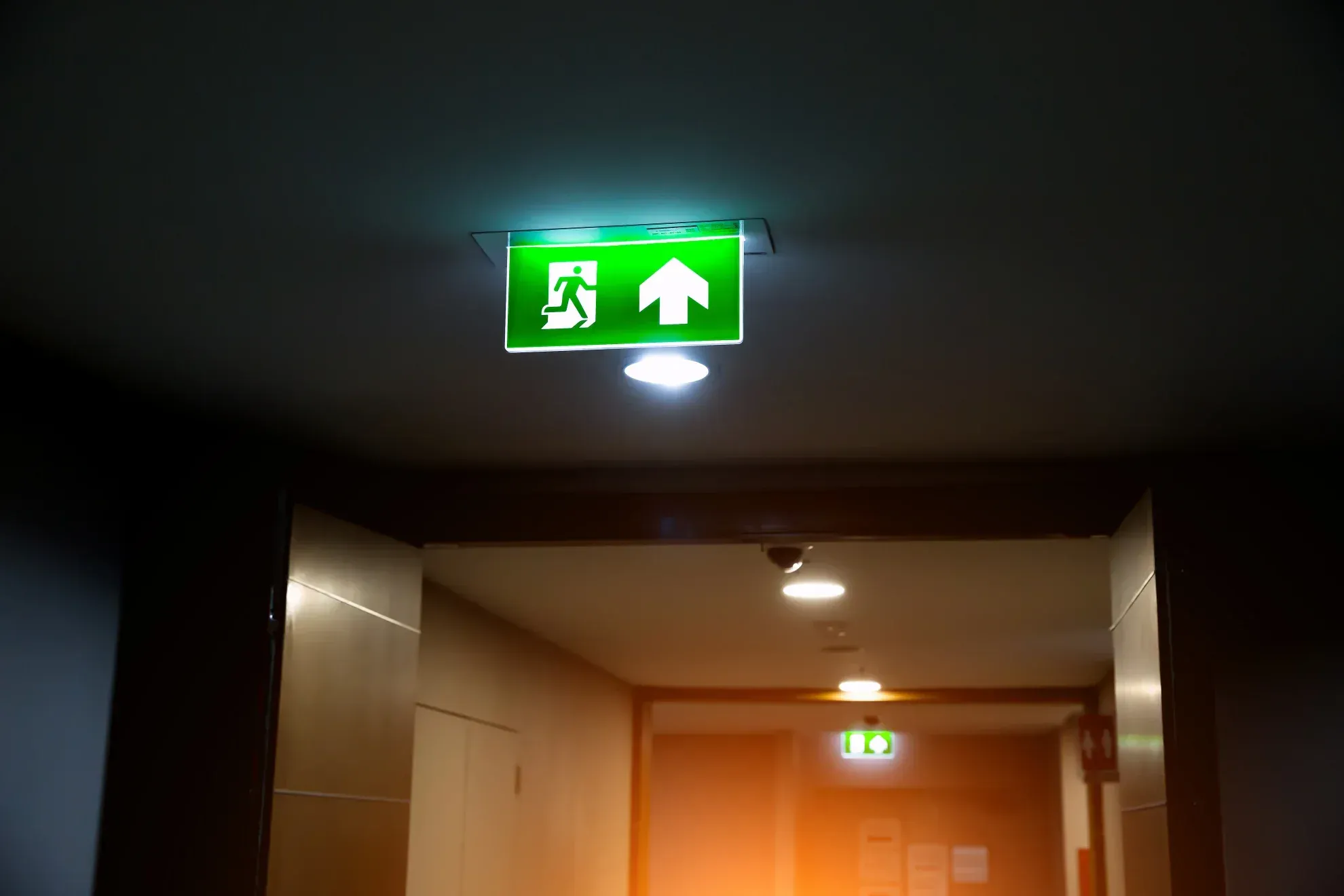
Is Testing Emergency Lighting a Legal Requirement?
Yes, for premises covered by the Regulatory Reform (Fire Safety) Order 2005. Article 14 says that, where necessary, "emergency routes and exits requiring illumination must be provided with emergency lighting of adequate intensity in the case of failure of their normal lighting." Article 17 then requires that equipment to be "subject to a suitable system of maintenance" and kept "in efficient working order and in good repair."
The law does not set the test schedule itself. That comes from the British Standard code of practice, BS 5266-1, which is how fire risk assessors, insurers and fire authorities judge whether your maintenance is suitable. Testing is the only way to know a battery fitting will actually work when the power fails, because a fitting that looks fine on the ceiling can have a battery that no longer holds its charge.
The duty falls on the "responsible person". That is usually the employer, or whoever controls the premises, such as the landlord or managing agent for the shared parts of a block of flats or an HMO. Private family homes are not covered.
The Testing Schedule at a Glance
| Test | How often | What happens | Who usually does it |
|---|---|---|---|
| Functional ("flick") test | Monthly | A short simulated power cut using the test key. Every fitting and exit sign is checked to see that it lights. | A competent person, often a trained member of staff |
| Full-duration test | Annually | The system runs on battery for its full rated duration, usually three hours, and every fitting is checked at the end. | A competent person, usually an electrician |
| Recording | After every test | Results, faults and repairs go in the log book. A test certificate is issued after the annual test. | Whoever carried out the test |
How to Do the Monthly Emergency Lighting Test
The FPA describes the monthly test as a "short functional test simulating failure of the mains power supply". It takes a few minutes for a small building, and it should be done with the proper test key rather than by turning lights off at the switch or the consumer unit.
- Find the key switches. Emergency lighting circuits have a small key switch, usually near the distribution board or beside the light switches for each area. The test key, often called a fish key because of its shape, fits into it.
- Turn the key. This cuts the supply to the emergency fittings on that circuit, so they switch to battery, while the normal lighting stays on. The FPA says, "The fish key should be used rather than switching off the mains lighting power."
- Walk the route. Check that every emergency light and exit sign on that circuit is lit. Note any that are dim, flickering or out.
- Restore the supply. Turn the key back and check that each fitting's charging indicator, usually a small green light, comes back on.
- Record it. Write the date, the result and any faults in the log book. The FPA says faults should be reported to the responsible person so they get fixed.
If one key switch covers the whole building, you will need two people or a quick walk round while the fittings are on battery. Keep the test short, because it drains the batteries slightly.
The Annual Full-Duration Test
Once a year, the system is tested for its full rated duration. The FPA's guidance on BS 5266-1 gives this as three hours. A few systems are designed for a shorter duration, and your design or completion certificate will say which yours is. The supply to the emergency fittings is switched off for the whole period, and at the end every fitting must still be lit. One that has gone out or dimmed has failed, and usually needs a new battery or lamp.
Because the batteries are flat afterwards and need time to recharge, the test is best done when the building is empty or quiet. The FPA recommends checking the building again once power is restored to make sure every fitting is charging, ideally before or after working hours. The annual test is also the point at which a test certificate is issued, recording the result for each fitting and any work needed.
What Goes in the Emergency Lighting Log Book
Every test should be written down. The FPA says a record of all monthly tests "must be kept", and that the log can record "the system test, defects, any damage to the system, and remedial action relating to each light." A simple log book entry should show:
- the date and which test was done (monthly or annual)
- who carried it out
- any fittings that failed or were damaged, by location
- what was done about each fault, and when
Keep the log book with your fire safety records. Your fire risk assessor, your insurer and the fire authority can all ask to see it, and gaps in the record are hard to explain after the event.
Self-Testing Emergency Lighting
Some fittings test themselves automatically and show the result on a status light, and larger systems can report results to a central panel. They save someone walking round with a key, but they do not remove the duty: someone still needs to check the results, act on failures and keep the record.
Emergency Lighting Certificates
There are two documents to keep. When a system is installed or altered, the installer should give you a certificate confirming it was designed and installed to the standard. After each annual full-duration test, you should get a test certificate recording the results. Together with the log book, these are the "emergency lighting certificate" a fire risk assessor or insurer asks for. They sit alongside the electrical certificates for the rest of the installation, and a PAT testing record if you supply appliances.
What Changed in BS 5266-1:2025
BSI published a full revision of the code of practice in late 2025. According to BSI, BS 5266-1:2025 supersedes the 2016 edition, widens the scope beyond escape lighting to cover local area lighting and standby lighting, and brings the standard into line with changes to the European standards on emergency lighting levels (EN 1838) and emergency escape lighting systems (EN 50172). If your system was designed or last reviewed under the 2016 edition, ask whoever carries out your next annual test or fire risk assessment review whether anything in the new edition affects your building.
Emergency Lighting Testing in Tunbridge Wells and Kent
Our team installs, tests and certifies emergency lighting for businesses, landlords and property managers across Tunbridge Wells and the surrounding towns, including Tonbridge, Sevenoaks and Maidstone. We carry out both monthly and annual testing, can set up a maintenance contract so the schedule is handled for you, and issue a test certificate after the annual test. Many clients book it alongside an EICR so both are renewed on the same visit. To arrange a test, get in touch for a free quote.